On Thursday, June 2, I went to Kloster Marienberg in a
nearby town called Helmstedt. I had
already been to the monastery once back in April to meet the Domina Mechtild
von Veltheim (similar to an abbess or prioress, she is the head of the
monastery now) and Ursula Roeper, a curator planning an exhibition at the
monastery. So on this return visit, I
was going to take photos in the textile treasury!
Kloster Marienberg
Kloster Marienberg in bloom
Kloster Marienberg is no longer a monastery, but houses a
small textile treasury and the attached church is now Lutheran. Marienberg was an Augustinian convent,
founded in the 12th century.
Though I don’t know of any textiles actually made in Marienberg, they
have acquired a super little collection since the creation of the Veltheim-Stiftung
(a foundation set up by Domina Charlotte von Veltheim to collect and conserve
medieval textiles) in the 19th century.
I arrived around 10:00am, met Domina von Veltheim and a
couple of the women from the restoration department for a quick coffee, and
then spent the entire day in the treasury, photographing to my little heart’s
content!
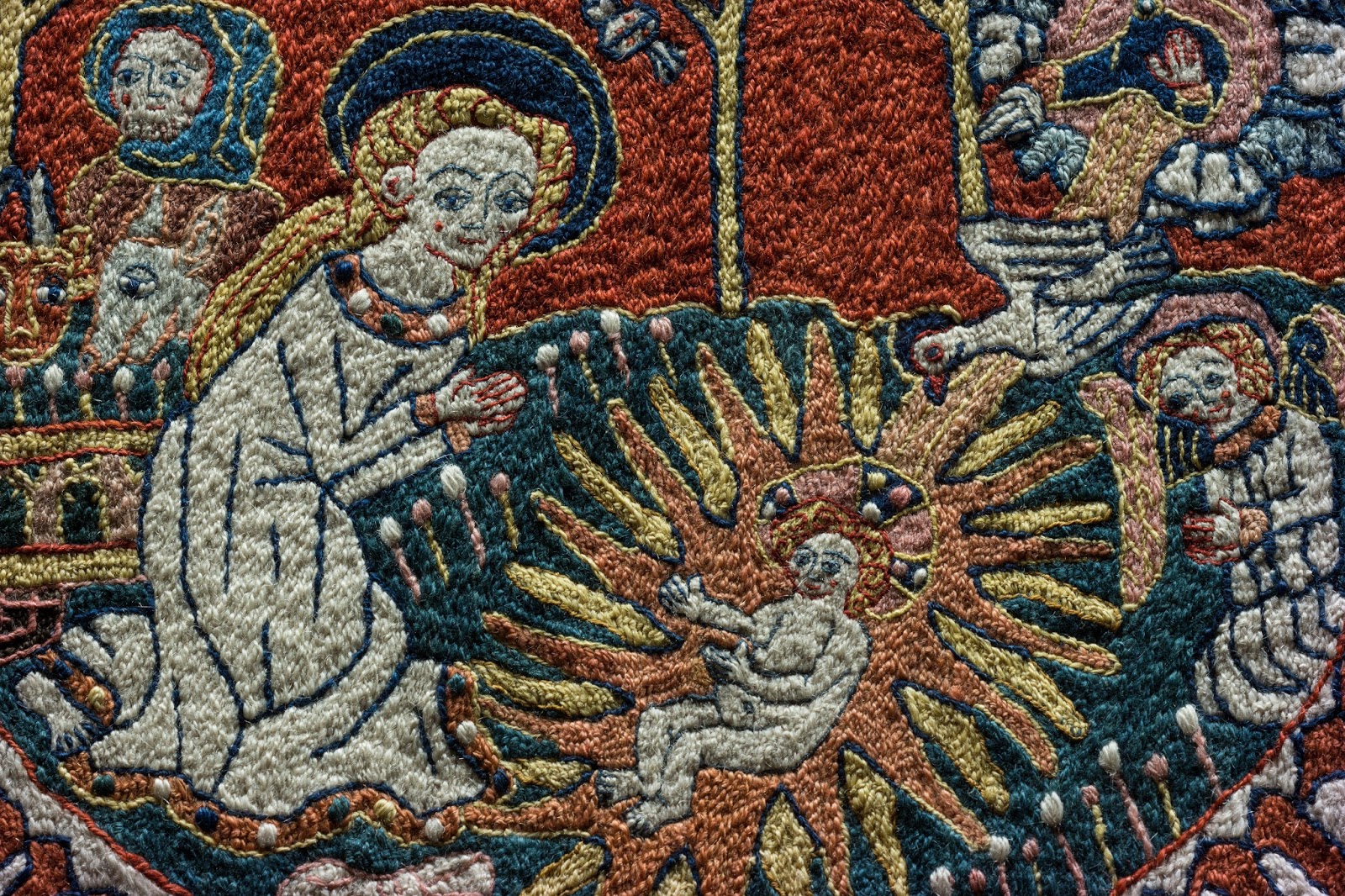
They have a couple 13th-14th century embroideries
showing scenes from the life of Saint Margaret.
Life of St. Margaret, 13th Century
Life of St. Margaret, 14th Century
Life of St. Margaret, 14th Century
I just LOVE these colorful patterns! Life of St. Margaret, 13th Century
More super patterns! Life of St. Margaret, 14th Century
The textile that depicts scenes from the Passion of Christ
(ca. 1450) is especially cool because it sports two sets of initials, assumed
to be from the embroiderers themselves.
Originally, the initials weren’t visible because they were sewn
underneath the border, but later restorations revealed the hidden letters.
Passion of Christ, ca. 1450
Crucifixion, Passion of Christ, ca. 1450
Little upside-down "GB" initials. Passion of Christ, ca. 1450
Sideways "MK" initials. Passion of Christ, ca. 1450
One of the nicest textiles they have is a Lenten cloth or antependium made
in Kloster Heiningen around 1260.
Another fabulous example of white work embroidery, the quality of the
silk, stitches, and its current state are all totally impressive!
Lenten cloth or antependium, ca. 1260, Kloster Heiningen
Christ in Majesty. Lenten cloth or antependium, ca. 1260, Kloster Heiningen
Virgin Mary. Lenten cloth or antependium, ca. 1260, Kloster Heiningen
Some super-detailed patterns! Lenten cloth or antependium, ca. 1260, Kloster Heiningen
They also have a couple interesting examples of embroideries
produced on black cloth, instead of the more common white/natural
background.
"Anna Selbdritt" (Saint Anne, with Mary and Christ child in her lap)
And last, but certainly not least, they are the proud owners
of a couple large-scale klosterstich embroideries in wool. These are very similar to the textiles made
and kept in Kloster Wienhausen (here) and Kloster Luene (here and here). Because these are not behind glass, I was
able to use my microscope attachment to get a closer look at the fibers of one
of these!!
Large klosterstich embroidery, Scenes from the Life of St. Elizabeth
These little yellow boxes indicate the location of the following micro details.
Microscope lens on bellows. Detail of red and green wool stitching.
Microscope lens on bellows. Detail of gray wool-- I love how you can see so many different colors up close!
Kloster Marienberg in Helmstedt is a really super
institution. It is small enough that you
can speak to real people who are interested in helping you, while it also has
the resources to undertake impressive restoration and conservation endeavors,
while also maintaining, displaying, and even loaning out a nice collection of
medieval textiles!
You may have noticed that nearly every weekend there is
something exciting happening here!! I’d
like to take this opportunity to catch you up on two very important annual
events in Wolfenbüttel —Entenrennen (Duck Race) and Buspulling (You guessed it!
Bus pulling).
On Saturday May 31, we
experienced the joy of the Entenrennen.
We all met up at the so-called “duck pond” in town to see the festivities,
and were impressed by the amount fan-fare involved! We all bought a rubber duckie for 2 Euro to
participate in the race. The duckies are
modeled after Gotthold Ephraim Lessing, the namesake of the Wolfenbüttel theater I mentioned
in an earlier post (here). They sport
his fashionable white wig, and carry a book under one wing and a horse (the
symbol of Lower Saxony) in the other.
Sophia buying her duckie! The anticipation is building!
You can see the resemblance, right?
All of the rubber duckies are taken up onto a bridge over
the Oker River and dumped in at the sound of the buzzer! They sort of dawdle down the small,
slow-moving river for about 100 yards before being funneled into a basket from
which they will choose the winners. The
first duckie to finish won their human a helicopter ride over Braunschweig-Wolfenbüttel—Needless
to say, I was relieved to not be the winner of such a “special” prize. They drew from the rest of the duckies to
pass out smaller, more children-oriented prizes later in the afternoon. Once the race was finished, you could
purchase a duckie to keep for another 2 Euro.
Of course we all did. All of the
proceeds benefit a childrens hospital in Wolfenbüttel.
The crowd on the bridge...
The release!!!!
Some real duckies were also involved...
I like to imagine that black cat is the referee.
After the race, we had a good time showing our Lessing ducks
around town!
The Entenrennen Crew: Anita, Matthias, Julia, and Sophia
Since I can't get up on this statue, my duckie had to do it for me!
The very next weekend, June 5, it was time for the Annual
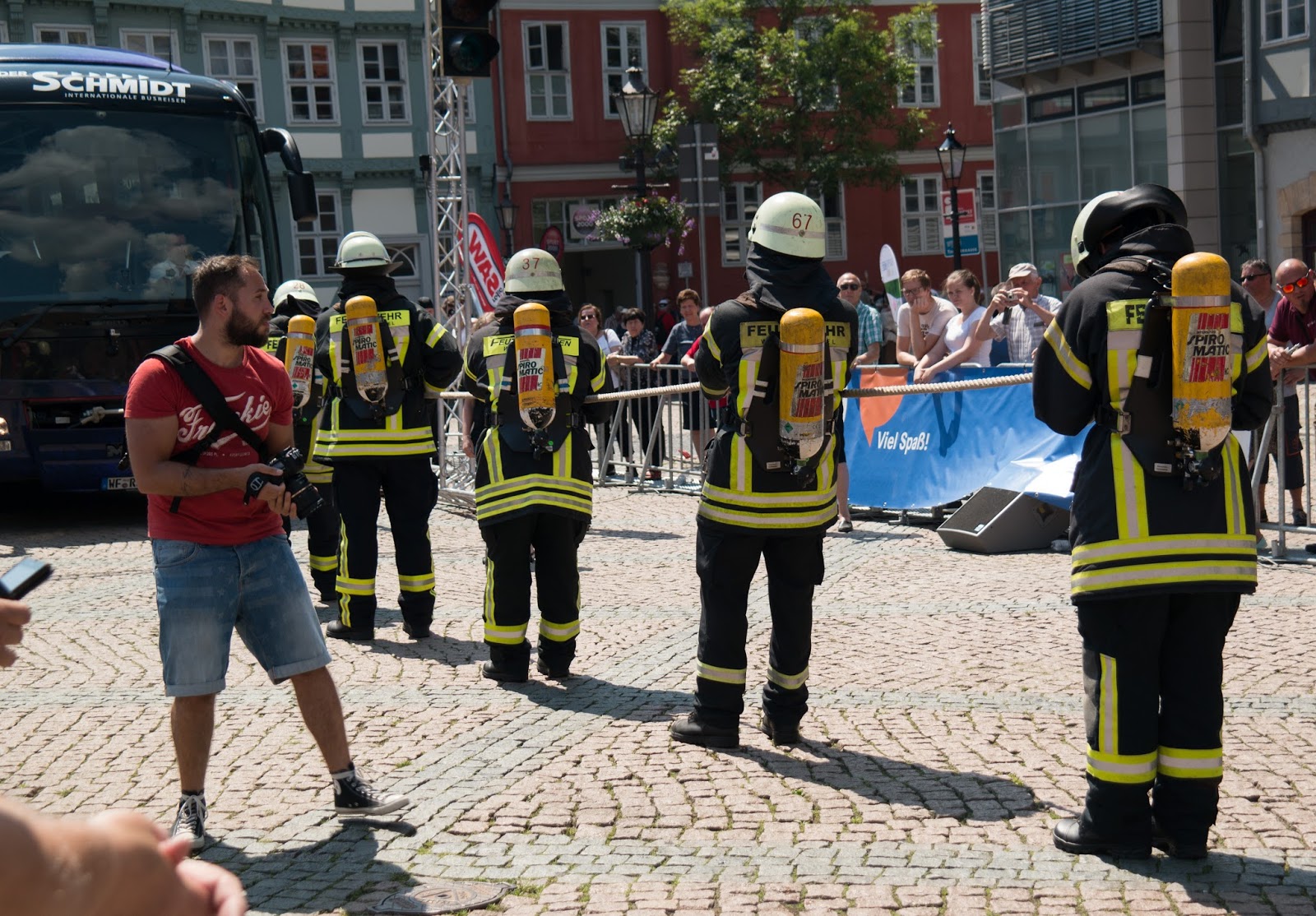
Bus Pulling Tournament! This is
apparently quite the tradition here in Wolfenbüttel… Fans come from all over to cheer on their
favorite 5-person bus-pulling teams! And by “all over,” I mostly mean within a
ten-mile radius. Nevertheless, they
enjoy calling it the “International World Tournament.” It is my understanding that it began with
mostly firefighters pulling fire trucks, and that most of the proceeds still go
to support regional fire departments.
Just a normal day in Wolfenbuettel...
This was the first passenger bus used in Wolfenbuettel! (That's what I'm saying and pointing out to Alberto, who took this picture...)
This Australian TV duo does a pretty good job introducing us
to the principals and excitement of the whole deal:
There were several rounds, with the best teams advancing each
time, until a winner was finally declared at the end of the day. There was even a women’s bracket! The teams consisted of six people, but only
five pull the bus. The sixth person just
follows the pullers and yells in their faces to go faster… I would like that
position on the team. The team must pull
the bus 30 meters, and the sum of the teams two fastest rounds are added
together. The fastest team wins.
Girl Power!
My favorite team of the day was the Wolfenbüttel Volunteer
Fire Department, because they showed up in their fire truck and pulled the bus
in full bunker gear. Their times were
not competitive, but they showed the most pizzazz!
Good work, guys! Thanks, Alberto, for capturing this special moment!
At the end of the day, the Almdudlers took home the prize,
and bragging rights across the globe!
And we all loved Wolfenbüttel even more.
I returned to Lüneburg on Friday, May 13, for the third time since first arriving in Germany back in October. I had been invited back to Kloster Lüne to attend a couple lectures about Lüneburg during the fifteenth-century reformation and the Protestant Reformation on Friday, and decided it would be a great time to take some more photos of their embroideries with newer equipment and more experience under my belt!
I stayed in the same room in the monastery, and it was so nice to see the familiar faces of the Conventalinnen and Abbess again! (The women in Kloster Lüne today are not "nuns," and the church is now Lutheran. The women are called Conventualin, and work to maintain the church, give tours, participate in the church community, etc. It is a cultural and even religious position, but they do not take any vows.) The Conventualin who always helps me out is named Charlotte, and I even got to meet her dog Grisela this time! But more on that later...
So I arrived on Friday afternoon, and attended the lectures that evening. The lectures are part of a series they are hosting called "Lüneburg on the Eve of Reformation." The first was about the reforms that took place in the monastery around 1480, which aimed for a return to strict observance of monastic vows. Then the second lecture discussed how the Lutheran Reformation affected the monastery, and how it was slowly converted to a Lutheran institution. The lectures were extremely well-attended! Afterward, there were finger-foods and local beer and fellowship. While I passed on the beer, I was able to catch up with Charlotte and the Abbess after the crowd died down.
I spent all day Saturday in the museum photographing the textiles again. I have so much more camera equipment now and a greater understanding of all of the photographic techniques than when I first went to Lüne, that I was very excited to get some new photos! I focused on the brightly-colored klosterstich embroideries made between 1500-1510, rather than the earlier "white work" embroideries, because I am especially interested in their particular aesthetic and the fact that they were produced after reformation efforts (which often slowed down artistic production).
Miracles of the Resurrected Christ, 1503-1507
Provost Choir Stall Hanging, 1508
Sibylls and Prophets, 1500-1502
Tree of Jesse, 1503-1505
This small scribe in the border of the Sibylls & Prophets has the initials of the nuns on the tablet!
Nun initials in the border of the Miracles of the Resurrected Christ
Saturday evening, we got to ring the church bells at 6:00pm and then I joined Charlotte for dinner and dog-walking. It was a very pleasant evening, and I loved watching Grisela play ball all by herself as she buried the ball under leaves, scratched around until it popped up, chased it, ad then did it all over again!
Ringing the bells in the nuns' gallery!
This shows where the ropes go up through the ceiling into the bell tower
Sunday (Pentecost) I went to church with the Conventualin, and was even able to sit up in the nuns' gallery! After church, I left the monastery and went into town to re-visit the large churches and check out the city museum. Sight-seeing was cut short by rain and hail, but it was certainly nice while it lasted! Was a great end to another super stay in Lüneburg!!